Zoology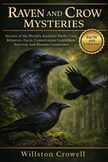
Introduction Ravens and crows have a way of entering human life like a question you can't ignore. You might see one standing perfectly still on a roadside post, watching the world with an expression that feels almost deliberate. You might hear a sharp caw from above and notice how the call seems to carry intention, as if it is aimed at someone, not simply broadcast into the air. Or you might notice the opposite-silence-and realize a group of crows has gone quiet the moment you stepped outside, as if your presence has been recorded and evaluated. These experiences can feel strangely personal, and that is exactly why ravens and crows have become two of the most talked-about, misunderstood, and mythologized birds on Earth.
This book, Raven and Crow Mysteries, is built for readers who want more than surface facts. It is for people who are drawn to the dark sheen of corvid feathers and the stories that cling to them, but who also want practical clarity: what these birds eat, how they live, what they need from their habitats, what to do when a young bird appears alone on the ground, how to safely and ethically feed wild birds without harming them, and what conservation actually looks like for species that are sometimes admired and sometimes persecuted. If you came here for wonder, you will find it. If you came here for guidance, you will also find it. Most of all, this book is designed to show how the wonder and the guidance belong together, because the mystery of ravens and crows becomes even more powerful when you understand the real biology beneath the legend.
Ravens and crows belong to the corvid family, a group known worldwide for exceptional intelligence. Their brains are large relative to their body size, and their behavior often looks like thinking. They solve problems, remember faces, learn routines, and adapt quickly to change. They are not the only smart animals in the world, but they are among the few that display intelligence in a way humans can easily notice. A crow dropping a hard nut onto a road so a car can crack it. A raven tugging repeatedly at a string to lift food. A group calling loudly to summon others to a food source or to mob a predator. Even when you are not trained in animal behavior, you can tell something complicated is happening. That sense of complexity is where many of the "mysteries" begin. People interpret the birds as messengers, guardians, tricksters, prophets, or symbols of death and transformation. Sometimes those interpretations are cultural wisdom. Sometimes they are misunderstandings. Often they are a mix of both.
One of the challenges-also one of the delights-of learning about ravens and crows is that they invite two kinds of attention at the same time. The first kind is scientific attention: observing what they actually do, how they communicate, how they hunt and forage, how they raise their young, and how they interact with their environment. The second kind is human attention: the stories we tell about them, the emotions they trigger, the meanings we attach to their presence, and the way their behaviors seem to mirror human concerns-family, territory, cooperation, conflict, survival, and memory. If you've ever felt uneasy when a crow stared at you too long, or comforted when you saw a raven on a quiet day, you've already experienced how the boundary between nature and meaning can blur. The goal of this book is not to mock that experience or to exaggerate it. The goal is to explain it, ground it, and make it useful-so you can appreciate ravens and crows without falling into harmful myths, and so you can coexist with them in ways that support their wellbeing and the health of the ecosystems they help shape.
Raven and Crow Mysteries
Secrets of the World's Smartest Birds: Care, Behavior, Facts, Conservation Symbolism, Survival, and Human Connection
by Willston Crowell (Author)
Paperback
$15.69List price:$16.88
You save $1.19 (7%)Ships in 1 to 2 business days
StandardArrives 4 to 10 days after it ships.ExpeditedArrives 2 to 5 days after it ships.We email you a tracking number when your order ships.
Customers rate DiscountMags 4.6/5 3,439 reviews on independent sites SmartCustomer, ResellerRatings and Trustpilot
30-day returns
Return it within 30 days of delivery for a refund of the price plus tax. It must be in its original condition, and shrink-wrapped items unopened. Return shipping (with tracking) is on you, and original shipping isn't refunded. Arrived damaged or wrong? Contact us first and we'll make it right.
Family-ownedSelling since 2002
About this book
This book, Raven and Crow Mysteries, is built for readers who want more than surface facts. It is for people who are drawn to the dark sheen of corvid feathers and the stories that cling to them, but who also want practical clarity: what these birds eat, how they live, what they need from their habitats, what to do when a young bird appears alone on the ground, how to safely and ethically feed wild birds without harming them, and what conservation actually looks like for species that are sometimes admired and sometimes persecuted. If you came here for wonder, you will find it. If you came here for guidance, you will also find it. Most of all, this book is designed to show how the wonder and the guidance belong together, because the mystery of ravens and crows becomes even more powerful when you understand the real biology beneath the legend.
Ravens and crows belong to the corvid family, a group known worldwide for exceptional intelligence. Their brains are large relative to their body size, and their behavior often looks like thinking. They solve problems, remember faces, learn routines, and adapt quickly to change. They are not the only smart animals in the world, but they are among the few that display intelligence in a way humans can easily notice. A crow dropping a hard nut onto a road so a car can crack it. A raven tugging repeatedly at a string to lift food. A group calling loudly to summon others to a food source or to mob a predator. Even when you are not trained in animal behavior, you can tell something complicated is happening. That sense of complexity is where many of the "mysteries" begin. People interpret the birds as messengers, guardians, tricksters, prophets, or symbols of death and transformation. Sometimes those interpretations are cultural wisdom. Sometimes they are misunderstandings. Often they are a mix of both.
One of the challenges-also one of the delights-of learning about ravens and crows is that they invite two kinds of attention at the same time. The first kind is scientific attention: observing what they actually do, how they communicate, how they hunt and forage, how they raise their young, and how they interact with their environment. The second kind is human attention: the stories we tell about them, the emotions they trigger, the meanings we attach to their presence, and the way their behaviors seem to mirror human concerns-family, territory, cooperation, conflict, survival, and memory. If you've ever felt uneasy when a crow stared at you too long, or comforted when you saw a raven on a quiet day, you've already experienced how the boundary between nature and meaning can blur. The goal of this book is not to mock that experience or to exaggerate it. The goal is to explain it, ground it, and make it useful-so you can appreciate ravens and crows without falling into harmful myths, and so you can coexist with them in ways that support their wellbeing and the health of the ecosystems they help shape.
Product details
- Format
- Paperback
- Publisher
- Independently Published
- Published
- December 21, 2025
- Pages
- 162
- Language
- English
- ISBN-13
- 9798279307548
- Dimensions
- 9 × 6 × 0.35 in
- Weight
- 0.5 lb
Subjects
Paperback$15.69$16.88